 +919979891672



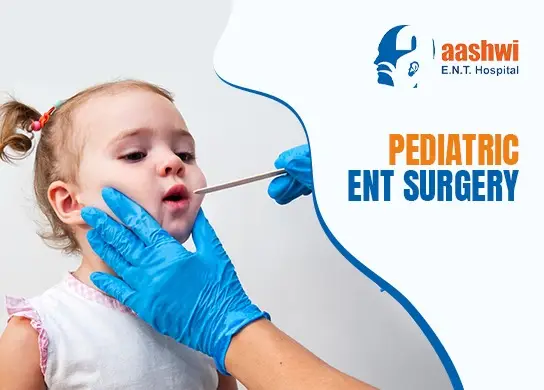
The moment a doctor mentions surgery for a child, every parent’s instinct is to find a reason why it is not necessary. That instinct is reasonable — surgery should always be a considered decision, not a default. But the opposite failure — avoiding necessary surgery while a child’s hearing declines, sleep becomes fragmented, or recurrent infections accumulate — carries its own costs. At Dr Manish Goyal’s pediatric ENT clinic in Bodakdev, Ahmedabad, the most consistent question from parents is not “what does the surgery involve” — it is “does my child actually need it?” This guide answers that question directly for the three most common pediatric ENT surgical procedures: adenoidectomy, tonsillectomy, adenotonsillectomy, and grommet insertion.
Pediatric ENT Surgery: When Is It Necessary and When Is Watchful Waiting the Better Choice
How the Surgical Decision Is Made
No responsible ENT surgeon recommends pediatric surgery without working through a structured decision framework. For Dr Manish Goyal, that framework involves three questions applied to every child referred for surgical assessment:
- Has conservative management been properly tried?
Mild-to-moderate presentations of adenoid hypertrophy, tonsillitis, and glue ear frequently respond to non-surgical management — nasal corticosteroid sprays for adenoid reduction, antibiotic courses for bacterial tonsillitis, and watchful waiting for glue ear that may resolve spontaneously. Surgery is indicated when these conservative approaches have been applied correctly and adequately without sufficient response — not before.
- Is the condition affecting the child’s development, health, or quality of life measurably?
The threshold for surgery is not “the condition exists” — it is “the condition is causing harm that surgery can prevent.” Recurrent tonsillitis that causes five or more days of school absence per episode is harming education. Glue ear that has suppressed hearing by 30 dB for more than three months during a child’s critical language development window is harming speech acquisition. Adenoid hypertrophy causing confirmed obstructive sleep apnea is harming growth and cognitive development. Quantifying the harm determines the urgency.
- Is the child’s anatomy and age suitable for the planned procedure?
Age, weight, comorbidities, and airway anatomy all affect anaesthetic risk. Dr Manish Goyal works within clear clinical guidelines — procedures in children under 12 months are rarely performed outside tertiary care settings; in children between one and three years, the risk-benefit analysis is weighted more carefully than in older children.

Adenoidectomy — Removing the Adenoids Alone
The adenoids — lymphoid tissue at the back of the nasal passage in the nasopharynx — are anatomically distinct from the tonsils and often cause problems independently. Adenoidectomy without simultaneous tonsillectomy is appropriate and common when the adenoids are the primary source of pathology and the tonsils are not significantly involved.
When adenoidectomy is indicated:
- Persistent nasal obstruction and mouth breathing — adenoid hypertrophy blocking nasal airflow, confirmed on nasal endoscopy or lateral neck X-ray, with associated habitual mouth breathing that does not respond to nasal steroid spray after six to twelve weeks
- Recurrent adenoiditis — repeated bacterial infection of the adenoid pad producing fever, nasal discharge, and cervical lymphadenopathy; more than four episodes per year despite appropriate antibiotic treatment
- Eustachian tube dysfunction and recurrent middle ear infections — enlarged adenoids obstructing the Eustachian tube opening and producing recurrent acute otitis media or persistent glue ear; adenoidectomy alone reduces middle ear infection frequency by approximately 50 percent in this group.
- Obstructive sleep-disordered breathing — when the adenoids are significantly enlarged and contributing to nighttime breathing obstruction in the absence of major tonsillar enlargement
Adenoidectomy is performed through the mouth under general anaesthesia using a curette, suction diathermy, or coblation technique. It takes 15 to 20 minutes. Recovery is faster than tonsillectomy — most children return to normal activity within three to five days.
Tonsillectomy and Adenotonsillectomy
Tonsillectomy removes the palatine tonsils — the two visible lymphoid masses on either side of the throat. It is performed alone when the tonsils are the primary problem and the adenoids are not, or combined with adenoidectomy (adenotonsillectomy) when both structures are contributing to obstruction or infection.
When tonsillectomy is indicated:
- Recurrent bacterial tonsillitis — the standard clinical threshold is seven or more confirmed episodes in one year, five or more per year for two consecutive years, or three or more per year for three years, each associated with fever, exudate on the tonsils, and significant functional impairment
- Peritonsillar abscess — a single peritonsillar abscess managed acutely may not require immediate tonsillectomy, but a second episode is a strong indication for elective surgery once the acute episode resolves.
- Obstructive sleep apnea confirmed on sleep study — enlarged tonsils contributing to significant nocturnal desaturation, particularly when AHI exceeds five events per hour in a child, and non-surgical management has not produced adequate improvement.
- Tonsil asymmetry with suspicious features — one tonsil significantly larger than the other without an obvious infectious cause requires biopsy to exclude malignancy before any surgical plan is made.
- Chronic tonsillitis with tonsilloliths — persistent low-grade tonsil infection producing bad breath, chronic throat discomfort, and recurrent tonsillar debris (tonsil stones) unresponsive to medical management
For Coblation® Tonsillectomy specifically — the technique Dr Manish Goyal uses — radiofrequency energy at low temperature removes tonsillar tissue with significantly less thermal spread to surrounding structures than conventional electrocautery. The result is less post-operative pain, lower risk of post-operative bleeding, and faster return to normal diet. In children, this translates directly to lower dehydration risk during recovery — one of the most common reasons for re-hospitalisation after traditional tonsillectomy.
Grommet Insertion — The Operation Most Parents Know Least About
Grommet insertion (myringotomy with ventilation tube placement) is one of the most commonly performed pediatric surgical procedures globally — and one of the least understood by parents, because the condition it treats (glue ear) is often asymptomatic in the child while causing measurable hearing loss and developmental impact.
What glue ear is: Otitis media with effusion — glue ear — is the accumulation of thick, viscous fluid in the middle ear behind an intact eardrum. Unlike acute ear infection, it is not painful. The child does not complain of earache. The first sign is often a teacher’s report that the child is not paying attention, or a parent noticing the child turns the television up louder than before, or a formal hearing test showing 25 to 40 dB of conductive hearing loss in both ears.
Glue ear is common — affecting approximately 80 percent of children at some point before age ten. The majority resolve spontaneously within three months. The children who need surgical intervention are those whose glue ear persists beyond three months with:
- Hearing loss of 25 dB or greater in the better ear across speech frequencies
- Documented impact on speech development, language acquisition, or school performance
- Recurrence following previous spontaneous resolution — three or more episodes in twelve months
What the grommet procedure involves: Under brief general anaesthesia — typically five to ten minutes — a small incision is made in the eardrum (myringotomy), and a tiny ventilation tube (grommet) is placed in the incision. The grommet allows air to enter the middle ear, equalising pressure and allowing the accumulated fluid to drain. Hearing typically improves immediately on recovery from anaesthesia — parents frequently describe the moment their child wakes up and begins hearing things they had not noticed before as among the most striking clinical outcomes they have witnessed.
Grommets remain in place for six to eighteen months, then fall out spontaneously as the eardrum heals around them. During this period, the ear requires monitoring and protection from water entry.
Is adenoidectomy performed at the same time? In children with recurrent glue ear — rather than a first episode — adenoidectomy is frequently combined with grommet insertion. Evidence shows that adenoidectomy reduces glue ear recurrence after grommet extrusion by approximately 50 percent, making combined surgery more durable than grommets alone in recurrent cases.
What the Assessment Involves Before Any Surgical Decision
At Dr Manish Goyal’s clinic, the pre-surgical assessment for a child includes:
- Nasal endoscopy — direct visualisation of the adenoid pad, nasopharynx, and Eustachian tube openings. The adenoids cannot be assessed without this — lateral X-ray provides only an approximate size measurement without functional context.
- Tympanometry — objective middle ear pressure measurement; a flat tympanogram on two examinations three months apart is a core criterion for grommet insertion.
- Pure tone audiometry — adapted to the child’s age; confirms the degree of hearing loss from glue ear.
- Sleep oximetry — where obstructive sleep apnea is suspected; confirms nocturnal desaturation before adenotonsillectomy is planned.
Frequently Asked Questions
Is general anaesthesia safe for young children?
Modern paediatric anaesthesia is extremely safe in accredited facilities. The risk of serious complications from general anaesthesia in healthy children is very low — lower than the untreated developmental consequences of conditions like persistent glue ear or obstructive sleep apnea in many cases. The decision is made with the child’s full health picture in mind, and Dr Manish Goyal coordinates with an experienced paediatric anaesthetist for all procedures.
Will removing tonsils and adenoids weaken my child’s immune system?
No — not in any clinically meaningful way. The tonsils and adenoids contribute to immune sampling in early childhood, but the immune system has extensive redundancy across other lymphoid tissue. Long-term studies consistently show that children who have adenotonsillectomy do not experience higher rates of infection than those who do not. Children with chronically infected tonsils often have fewer infections after removal because the persistent bacterial reservoir is gone.
How soon does hearing improve after grommet insertion?
In most children, hearing improvement is immediate — parents notice it in the recovery room or the same day as the procedure. The middle ear fluid drains through the grommet within the first 24 to 48 hours, and with it, the conductive component of the hearing loss resolves. Any residual hearing loss after the fluid has cleared suggests a sensorineural component that needs separate audiological assessment.
Can grommets fall out too early?
Yes — in a small proportion of children, grommets extrude within three to six months rather than the expected six to eighteen months. This can happen from particularly vigorous mucociliary clearance or from specific grommet types. If glue ear recurs after early extrusion, a second grommet insertion or combined adenoidectomy at the time of re-insertion is discussed. Dr Manish Goyal monitors grommet status at follow-up appointments and manages early extrusion with the parent’s full involvement in the decision.
What happens if ENT surgery is delayed when it is genuinely needed?
The consequences are condition-specific. Delayed tonsillectomy for recurrent tonsillitis means more school absences, more antibiotic courses, and increasing tonsillar scarring that may complicate later surgery. Delayed grommet insertion for persistent glue ear means continued hearing loss during the most critical window for language and speech development. Delayed adenotonsillectomy for confirmed obstructive sleep apnea means continued growth hormone disruption, cognitive impairment from sleep fragmentation, and in some cases, cardiovascular changes from repeated nocturnal hypoxia. The timing of surgery matters.
Does my child need a referral to see Dr Manish Goyal for a pediatric ENT assessment? No referral is required. Parents can book an appointment directly at drmanishgoyal.com or by calling +91 99798 91672. The initial consultation involves the full assessment described above — nasal endoscopy, tympanometry, and audiometry where indicated — and produces a clear recommendation at the first visit rather than requiring multiple return appointments for staged assessment.
The Question Is Not Whether Surgery Is Scary — It Is Whether Waiting Is Safer
Surgery in children is always a considered decision. But the calculation is not surgery versus no surgery — it is surgery versus the ongoing harm of the untreated condition. For children who have crossed the clinical thresholds for tonsillectomy, adenoidectomy, or grommet insertion, the evidence consistently shows that appropriate surgical intervention produces better outcomes than continued observation.
Dr Manish Goyal’s pediatric ENT practice in Bodakdev, Ahmedabad offers the full assessment and, where surgery is indicated, the surgical expertise — with Coblation® technique for tonsillectomy — to intervene as safely and recover as fast as current ENT practice allows.
Book your child’s ENT assessment today.
📍 Dr Manish Goyal — 25, Sumangalam Co-op Housing Society, Drive-In Road, opp. Sunset Drive Cinema, Bodakdev, Ahmedabad – 380054 📞 +91 99798 91672
For more information, click below:

No Comments