 +919979891672



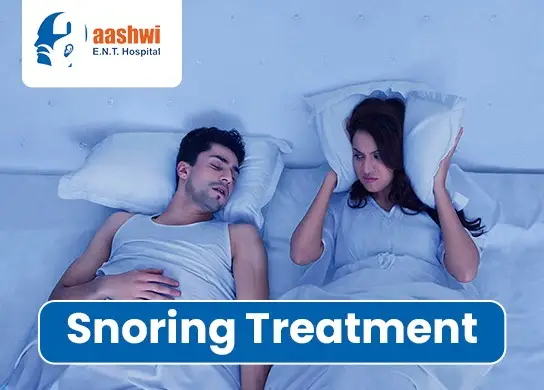
Snoring is not just a noise problem. In many people, it is the audible signal of a partially obstructed airway — and when that obstruction is severe enough to cause repeated breathing pauses during sleep, it becomes obstructive sleep apnea, a condition with direct consequences for cardiovascular health, blood pressure, blood sugar regulation, and long-term cognitive function. The right snoring treatment depends on identifying where in the upper airway the obstruction is occurring and how severe it is — which is exactly what Dr Manish Goyal’s Snoring and Sleep Apnea Clinic in Ahmedabad is designed to do.
This guide explains the difference between simple snoring and sleep apnea, the most common causes of airway obstruction during sleep, and the full range of treatment options — from conservative measures to surgical intervention.
Best Snoring Treatment & Sleep Apnea Solutions: What an ENT Specialist Actually Does
Snoring vs Sleep Apnea — Why the Distinction Matters
Every person with obstructive sleep apnea snores. But not every person who snores has sleep apnea. This distinction is clinically important because the two conditions carry very different health implications and require different treatment intensities.
Simple snoring happens when soft tissue in the upper airway — the soft palate, uvula, tongue base, or pharyngeal walls — vibrates as air passes through a narrowed space during sleep. It is noisy and disruptive to the bed partner, but the person breathing continues to move adequate air throughout the night.
Obstructive sleep apnea occurs when the airway collapses sufficiently to reduce or completely stop airflow for ten seconds or longer, repeatedly through the night. The brain detects falling oxygen levels and triggers a brief arousal — the person gasps, partially wakes, and the airway reopens. This cycle can occur five to thirty times per hour in moderate cases, and over thirty times per hour in severe sleep apnea. The person has no memory of these arousals but wakes exhausted, unrefreshed, and progressively accumulates a sleep debt that affects every system in the body.
The critical sign that separates the two: witnessed apneas — a partner watching the person stop breathing and then gasp — and daytime symptoms — profound fatigue, morning headache, poor concentration, falling asleep unintentionally during the day.
What Is Actually Causing the Obstruction
The upper airway collapses during sleep at its narrowest point. Identifying that point — and understanding why it narrows — is the starting place for effective treatment.
The most common structural contributors are:
- Enlarged tonsils and adenoids — particularly in children, where tonsillar enlargement is the leading cause of obstructive sleep apnea. In adults, persistently large tonsils continue to contribute. Tonsillectomy in appropriately selected patients produces dramatic improvement in airway calibre.
- Deviated nasal septum and nasal congestion — nasal obstruction forces mouth breathing during sleep, which changes the tongue position and increases pharyngeal collapse. Treating nasal obstruction — whether structural or allergic — often meaningfully reduces snoring severity.
- Soft palate and uvula laxity — the soft palate elongates with age and weight gain. A long, floppy soft palate vibrates with airflow and in some positions falls against the pharyngeal wall, partially blocking the airway.
- Tongue base enlargement — a large or posteriorly positioned tongue falls toward the airway during sleep, particularly when lying on the back. This is one of the more complex anatomical contributors to manage.
- Obesity — fat deposition in the neck and pharyngeal tissues narrows the airway circumference. A 10 percent reduction in body weight in obese patients produces meaningful improvement in apnea severity in many cases.
- Low muscle tone — alcohol consumption, sedative medication, and muscle relaxants reduce upper airway tone during sleep and acutely worsen both snoring and apnea severity.
Diagnosing Sleep Apnea — The Sleep Study
No treatment decision for suspected sleep apnea should be made without objective confirmation of the diagnosis and severity. This is what a sleep study provides.
Dr Manish Goyal’s clinic in Ahmedabad offers sleep study assessment as part of the snoring and sleep apnea evaluation pathway. A sleep study — either a full polysomnography in a sleep lab or a home sleep apnea test — records breathing effort, airflow, oxygen saturation, heart rate, and body position through the night. The results give an Apnea-Hypopnea Index (AHI): the number of breathing events per hour.
- AHI below 5 — normal
- AHI 5 to 14 — mild sleep apnea
- AHI 15 to 29 — moderate sleep apnea
- AHI 30 or above — severe sleep apnea
This number, combined with the clinical picture, determines which treatment pathway is appropriate. Treating severe sleep apnea with snoring remedies designed for simple snoring is both inadequate and potentially dangerous — it creates the impression of management without addressing the underlying health risk.
Conservative Measures That Genuinely Help
For mild sleep apnea and simple snoring, lifestyle measures produce meaningful improvement and should be fully implemented before any procedural intervention:
- Weight loss — the single most effective non-surgical intervention for overweight patients with sleep apnea. A 10 percent reduction in body weight reduces AHI by approximately 26 percent on average.
- Positional therapy — most people snore and have more apnea events when sleeping on their back. Sleeping on the side consistently can reduce AHI significantly in position-dependent cases. Purpose-made positional pillows or devices maintain lateral positioning through the night.
- Alcohol and sedative avoidance — eliminating alcohol within three to four hours of sleep and reviewing any sedative or muscle-relaxant medications removes a significant and reversible airway tone reduction.
- Nasal hygiene — treating allergic rhinitis, using daily saline nasal rinses, and managing nasal congestion reduces the mouth-breathing pattern that worsens pharyngeal collapse during sleep.
- Mandibular advancement devices (MAD) — custom-fitted oral appliances that hold the lower jaw slightly forward during sleep, tensioning the tongue and pharyngeal soft tissue and reducing collapse. Effective in mild to moderate sleep apnea. Fitted by a dentist in collaboration with the ENT assessment.
CPAP — The Gold Standard and Its Limitations
Continuous Positive Airway Pressure therapy — CPAP — is the most effective treatment for moderate and severe obstructive sleep apnea. A device delivers pressurised air through a mask worn during sleep, acting as a pneumatic splint that keeps the airway open throughout the night.
When tolerated, CPAP is transformative. Patients with severe sleep apnea who use CPAP consistently report restored energy, improved cognitive function, better blood pressure control, and reduced cardiovascular risk within weeks.
The limitation is compliance. Between 30 and 50 percent of patients prescribed CPAP either do not initiate it or abandon it within the first year. The mask is uncomfortable for some, claustrophobic for others. Pressure intolerance, skin irritation, and noise from the device are common complaints. For patients who cannot tolerate CPAP, the condition goes untreated — with all its associated health consequences — unless an alternative is found.
This is where surgical and other procedural CPAP alternatives become clinically important.
Surgical Snoring Treatment and Sleep Apnea Surgery
Surgery is appropriate when conservative treatment has not produced adequate relief, when CPAP is not tolerated, or when a specific structural abnormality is identified that can be corrected directly. Dr Manish Goyal performs snoring and sleep surgery using Erbe equipment, laser, and coblator technology at his clinic in Bodakdev, Ahmedabad.
The surgical options are matched to the level of obstruction found on examination:
- Tonsillectomy and adenoidectomy — for patients with significantly enlarged tonsils, Coblation® Tonsillectomy reduces tonsillar tissue with minimal thermal damage and a faster recovery than conventional techniques. In children with sleep apnea caused by tonsillar enlargement, this surgery is often curative.
- Uvulopalatopharyngoplasty (UPPP) — surgical reshaping and tightening of the soft palate, uvula, and pharyngeal walls. Performed under general anaesthesia using laser or coblator. Reduces palatal vibration and enlarges the airway at the soft palate level. Most effective for simple snoring and mild to moderate sleep apnea with palatal obstruction as the primary site.
- Laser-assisted uvulopalatoplasty (LAUP) — a less extensive palatal procedure using laser, often performed in staged sessions under local anaesthesia. Appropriate for patients with primary palatal snoring without significant apnea.
- Septoplasty and turbinate reduction — correcting nasal obstruction that is driving mouth breathing and worsening airway collapse. Often performed alongside palatal surgery when both levels contribute to the problem.
- Radiofrequency ablation of the soft palate and tongue base — minimally invasive office procedures using radiofrequency energy to stiffen and shrink soft tissue at the palate or tongue base level. Reduces tissue volume and vibration with minimal downtime.
Choosing the Right Treatment for Your Situation
The treatment that works for one patient does not work for all. A patient with simple palatal snoring and no sleep apnea needs a different pathway than a patient with severe sleep apnea driven by tongue base collapse. Someone who has tried and failed CPAP needs a different conversation than someone newly diagnosed.
At Dr Manish Goyal’s clinic in Ahmedabad, the evaluation for snoring and sleep apnea follows a structured sequence: clinical history and sleep questionnaire, upper airway examination including flexible laryngoscopy, sleep study where indicated, and a treatment discussion that matches the findings to the available options — not a one-size recommendation.
Book an appointment to begin that evaluation.
FAQs
Is snoring always a sign of sleep apnea?
No. Snoring is airway vibration. Sleep apnea involves repeated breathing pauses, oxygen drops, and daytime fatigue. A sleep study confirms it.
What are the best CPAP alternatives for sleep apnea?
Mandibular devices, positional therapy, weight loss, and ENT surgery are the main alternatives. The right one depends on obstruction site and severity.
Can snoring surgery cure sleep apnea completely?
Surgery reduces severity significantly in most patients. Complete cure is more likely in children. Adults typically see 50 percent or greater improvement.
How do I know if I have sleep apnea or just heavy snoring?
Daytime fatigue, morning headaches, poor concentration, and witnessed breathing pauses strongly suggest sleep apnea. A sleep study confirms the diagnosis accurately.
Does losing weight cure sleep apnea?
Weight loss reduces apnea events meaningfully — 10 percent weight loss cuts events by 26 percent. Structural cases still need separate treatment.
What happens if obstructive sleep apnea is left untreated?
Untreated sleep apnea raises risk of hypertension, heart disease, stroke, worsening diabetes, and cognitive decline. Long-term consequences accumulate silently over years.
The Snoring Your Partner Hears at Night Is Your Airway Asking for Help
Most people who snore loudly have been doing it for years before they seek evaluation — normalising the sound, dismissing the fatigue, attributing the poor sleep to stress or age. By the time they come in, the cardiovascular consequences are already in motion.
Dr Manish Goyal’s Snoring and Sleep Apnea Clinic in Bodakdev, Ahmedabad offers the full evaluation and treatment pathway — from sleep study to surgical intervention — using laser, coblator, and Erbe equipment for snoring surgeries. Whether your situation calls for a mandibular device, a palatal procedure, or a structured CPAP alternative plan, the starting point is a proper assessment.
📍 Dr Manish Goyal — 25, Sumangalam Co-op Housing Society, Drive-In Road, opp. Sunset Drive Cinema, Bodakdev, Ahmedabad – 380054 📞 +91 99798 91672
For more information, click below:

No Comments